Blog
HIFU vs Surgical Facelift: More Than Tech, It’s the Ultimate Business Showdown
In the multi-billion dollar anti-aging market, competition is fierce, and consumer demand is insatiable. Among the myriad of treatments, “facial lifting” remains one of the most coveted, high-value services. For you, the clinic owner or investor, this presents a critical dilemma, often crystallizing into the core business question of HIFU vs. Surgical Facelift: Should you invest in the definitive results of surgical intervention or embrace the flexibility and broad appeal of non-invasive technology?
The choice is a strategic one, defining your clinic’s market position, operational model, and ultimate profitability. Today, we dissect the three leading contenders in the battle for facial rejuvenation:
- The Surgical “Gold Standard”:SMAS Facelift (Superficial Musculoaponeurotic System)
- The Surgical “Technical Apex”:Deep Plane Facelift
- The Non-Invasive “Star Technology”:HIFU (High-Intensity Focused Ultrasound)
This article moves beyond a simple technical overview. We will conduct a deep-dive analysis across five crucial dimensions—Principle, Efficacy, Client Experience, Operations, and Business Model—to provide a robust framework for your next major investment decision.
A Quick Tour of Facial Anatomy—What Lies Beneath the Skin?
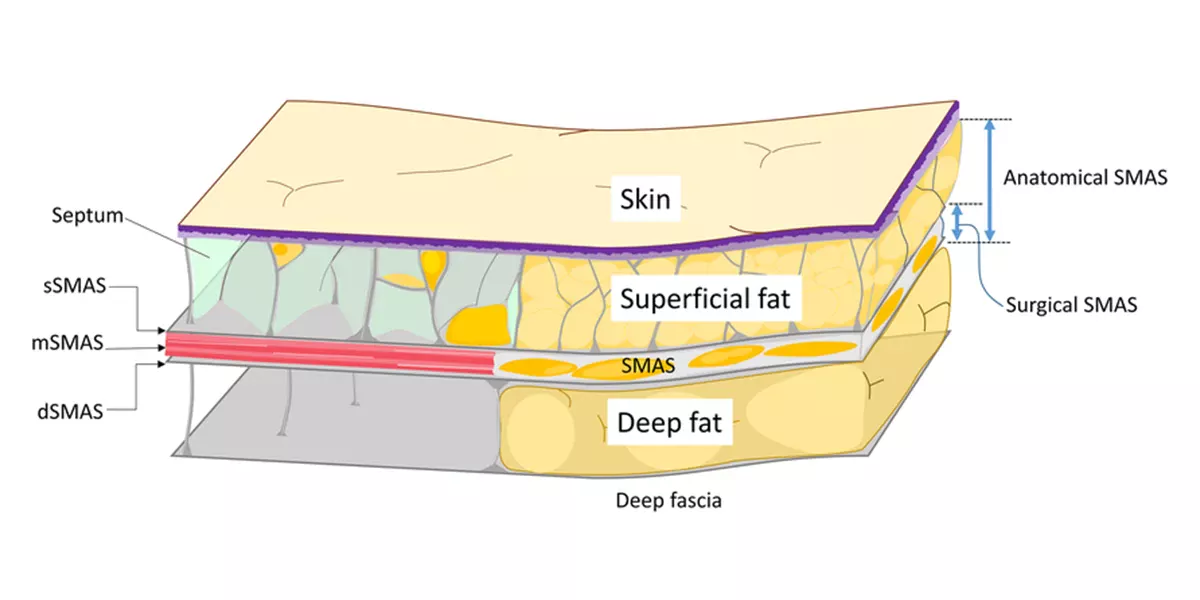
Before comparing these technologies, it’s crucial to understand the battlefield: the layers of the human face. This is where you’ll place your accompanying diagram. From superficial to deep, the key layers relevant to facial aging and lifting are:
- Epidermis:The outermost protective layer. It’s what we see, but most advanced lifting treatments aim to work beneath it.
- Dermis :Located beneath the epidermis, this is the vital layer rich in collagen and elastin—the proteins that give skin its firmness and elasticity. Many treatments target this layer to stimulate rejuvenation.
- Subcutaneous Tissue :This layer is primarily composed of fat pads, which provide facial volume and contour. With age, these fat pads can shrink and descend.
- SMAS:This is the game-changer. The Superficial Musculoaponeurotic System (SMAS) is a fibrous network that envelops the facial muscles and connects them to the dermis above. It acts as the deep scaffolding for the face. When the SMAS sags, the overlying skin and fat sag with it. Therefore, truly effective lifting must address this foundational layer.
Understanding these layers is key to appreciating why targeting the SMAS is the “holy grail” of facial lifting, whether by surgical or non-invasive means.
Dimension 1: Principle & Targeting—A Deep Dive from Skin to Fascia
Understanding how each technology works is fundamental to grasping its business implications. The magic happens at different depths and with entirely different methods.
SMAS Facelift
The SMAS facelift is a surgical procedure that has long been considered the gold standard. An incision is made, typically along the hairline and around the ear, allowing the surgeon to separate the skin from the underlying SMAS layer. This deeper fascial layer, which is a primary driver of facial sagging, is then tightened, repositioned, and secured with sutures.
- Analogy:Imagine your facial structure is a bed. The skin is the bedsheet, and the SMAS is the mattress underneath. A SMAS lift tightens the sagging mattress, which in turn smooths out the bedsheet on top.
- Target Layer:Directly manipulates the SMAS fascia.
Deep Plane Facelift
This is a more advanced and complex surgical technique. Instead of separating the skin from the SMAS, the surgeon dissects underneath the SMAS layer. This allows the skin, muscle, and SMAS to be lifted and repositioned as a single, composite unit. Crucially, this technique also involves releasing key facial ligaments that tether the deep tissues, allowing for a more significant and natural-looking lift, especially in the mid-face and jawline.
- Analogy:Going beyond just tightening the mattress (SMAS), a deep plane lift repositions the entire mattress and its underlying support structure, adjusting the very foundation of the bed.
- Target Layer:Sub-SMAS plane, including the release of facial retaining ligaments.
HIFU (High-Intensity Focused Ultrasound)
HIFU stands in stark contrast as a completely non-invasive technology. It uses focused ultrasound energy to generate precise heat at specific depths beneath the skin, without harming the surface. This energy creates thousands of microscopic thermal coagulation points (TCPs) at depths of 1.5mm, 3.0mm, and, most importantly, 4.5mm—the typical depth of the SMAS layer. This thermal effect causes immediate tissue contraction and, more significantly, triggers a powerful wound-healing response that stimulates long-term collagen and elastin production.
- Analogy:HIFU is like using thousands of “invisible, internal threads” to stitch and tighten the SMAS layer from within, prompting the body to rebuild and firm up its own support structure.
- Target Layer:Precisely targets multiple layers, including the dermis, deep fat, and the SMAS fascia.
| Feature | SMAS Facelift | Deep Plane Facelift | HIFU |
|---|---|---|---|
| Method | Surgical Incision & Suture | Surgical Incision & Deep Dissection | Non-Invasive Ultrasound |
| Energy Source | Mechanical (Surgical Tools) | Mechanical (Surgical Tools) | Acoustic (Ultrasound) |
| Target Depth | SMAS Layer | Sub-SMAS Plane & Ligaments | Multiple Depths (1.5, 3.0, 4.5mm) |
| Invasiveness | Highly Invasive | Extremely Invasive | Non-Invasive |
Dimension 2: Clinical Efficacy & Longevity—Immediacy, Peak, and Maintenance
Results are what clients pay for, but the nature of those results defines your business model.
Effect Presentation:
- Surgery (SMAS/Deep Plane):The results are immediate, dramatic, and transformative. This is the main appeal for clients seeking a major change. However, this significant alteration also carries the risk of an “overdone” or unnatural look if not performed with exceptional skill.
- HIFU:Clients often notice some immediate tightening, but the true magic unfolds over 2-3 months as new collagen is generated. The result is gradual, progressive, and exceptionally natural-looking, avoiding the tell-tale signs of intervention.
Effect Longevity:
- Surgery (SMAS/Deep Plane):The results are long-lasting, typically enduring for 5-10 years or even more.
- HIFU:Effects generally last for 1-2 years, depending on the individual’s aging process and lifestyle.
B2B Business Interpretation:
This difference in longevity is a critical strategic point.
- The Surgical Model:This is a “one-time, high-ticket” You secure a very large fee, but the client’s return cycle for the same procedure is extremely long. Your business relies on a constant stream of new, high-net-worth clients.
- The HIFU Model:This is a “repeatable, high-value” The 1-2 year longevity is not a weakness; it’s a commercial strength. It transforms a one-off procedure into an annual or biennial maintenance program, creating predictable, recurring revenue. This model excels at building client loyalty and maximizing Lifetime Value (LTV), fostering a stable cash flow for your clinic.
Dimension 3: Safety & Client Experience—Risk, Pain, and Downtime
The client’s journey is as important as the destination. This is where non-invasive technology truly shines.
Safety & Risks:
- Surgery (SMAS/Deep Plane):Carries all inherent surgical risks, including adverse reactions to anesthesia, infection, bleeding, hematoma, potential nerve damage (leading to temporary or permanent facial weakness), and scarring.
- HIFU:Boasts an outstanding safety profile. Risks are minimal and transient, typically limited to mild redness, swelling, or a tingling/soreness sensation that resolves within hours or days. There is no risk of scarring or permanent injury.
Pain & Comfort:
- Surgery (SMAS/Deep Plane):The procedure is painless under general anesthesia, but the post-operative period involves significant pain and discomfort requiring prescription medication.
- HIFU:The treatment involves sensations of heat and tingling, which can be uncomfortable but are generally well-tolerated by patients. No anesthesia is required.
Recovery (Downtime):
- Surgery (SMAS/Deep Plane):Requires extensive downtime. Patients can expect significant swelling and bruising for several weeks, with a full return to social and professional life taking up to a month or more.
- HIFU:Famously known as a “lunchtime procedure.” There is zero downtime. Clients can immediately resume all normal activities, making it the ultimate convenience-driven treatment.
B2B Business Interpretation:
Zero downtime is HIFU’s superpower for market penetration. It dramatically lowers the decision-making barrier for a vast demographic of busy professionals, parents, and individuals who cannot afford the social or career interruption of a surgical recovery. It aligns perfectly with the modern consumer’s demand for effective, efficient, and low-risk aesthetic solutions.
Dimension 4: Personnel & Operations—Building Your Expert Team & Environment
The back-end requirements to offer these services are vastly different and directly impact your scalability and operational costs.
| Feature | Surgical Facelifts (SMAS/Deep Plane) | HIFU |
|---|---|---|
| Practitioner | Board-Certified, experienced Plastic Surgeon | Doctor, Nurse, or trained Technician (under supervision) |
| Training Curve | Extremely steep; years of surgical residency | Standardized; can be mastered in a short course |
| Staffing Costs | Extremely high; surgeons are a scarce, expensive resource | Manageable; wider talent pool available |
| Facility Needs | Certified operating room, anesthesia, recovery suites | A single, private treatment room |
B2B Business Interpretation:
The operational divide is clear. Surgical facelifts represent a heavy-asset, high-barrier operational model. It requires immense capital investment in facilities and top-tier surgical talent, which is difficult to recruit and retain.
HIFU, conversely, is a light-asset, high-flexibility operational model. The device can be integrated into almost any existing clinic environment with minimal overhead. Staff can be trained through standardized protocols, making the service scalable and easy to delegate. This allows for rapid deployment, easier team expansion, and a much faster path to profitability for most non-surgical aesthetic practices.

Dimension 5: HIFU vs. Surgical Facelift: The Business Model & Market Showdown
Finally, let’s talk numbers—the investment, the pricing, and the customer you’re targeting.
Upfront Investment Cost:
- Surgery (SMAS/Deep Plane):Extremely high. This includes not just surgical tools but the construction and certification of an operating theater, which can run into hundreds of thousands of dollars.
- HIFU:Represents a moderate-to-high capital investment for a premium, medical-grade device. However, this is a fraction of the cost required for a full surgical setup.
Pricing Strategy & Client Affordability:
- Surgery (SMAS/Deep Plane):Priced as a top-tier luxury service, often ranging from $20,000 to $100,000+. This limits the target market to a very narrow segment of high-net-worth individuals.
- HIFU:Positioned as an “affordable luxury.” While still a premium service (typically priced from $1,500 to $5,000), it is accessible to a much broader demographic.
Insurance Coverage:
It is critical to note that all three procedures are considered cosmetic and are not covered by medical insurance. This is a level playing field where clients pay 100% out-of-pocket. This fact further amplifies HIFU’s advantage. Clinics can and should leverage this by offering in-house financing or third-party payment plans, making a $3,000 procedure vastly more accessible than a $30,000 one.
Target Client Persona:
- Surgery Client:Typically 55+, with significant facial sagging, a high disposable income, the ability to take extended time off for recovery, and a desire for a fundamental, once-in-a-decade change.
- HIFU Client:A much larger and faster-growing market. Typically 30-55, experiencing mild-to-moderate laxity (“pre-juvenation” or correction), seeking natural results, risk-averse, has no time for downtime, and possesses the capacity for consistent investment in their appearance. This is the “new middle class,” the “executive professional,” and the “sophisticated self-carer.”

Conclusion: Choosing the Right Growth Engine for Your Clinic
Let’s summarize the strategic choice before you.
- Surgery offers unparalleled results but demands a high-risk, high-cost, operationally complex business model that serves a niche market.
- HIFU offers natural, effective results with an unmatched safety profile and zero downtime, all within a flexible, scalable, and highly profitable business model that appeals to a massive and growing consumer base.
Here is your decision-making matrix:
For Large, Comprehensive Hospitals or Elite Plastic Surgery Centers: Surgical facelifts are your cornerstone, cementing your status as a top-tier provider. HIFU should be integrated as a vital complementary service—a gateway for non-surgical clients, a maintenance tool for post-surgical patients, and a “pre-juvenation” option for younger demographics, thus creating a complete service loop.
For Small to Mid-Sized Aesthetic Clinics, Dermatology Practices, and MedSpas: HIFU is, without question, your ideal growth engine. It is the most logical and profitable entry point into the high-value lifting and tightening market. It perfectly balances efficacy, safety, operational simplicity, and return on investment, allowing you to compete effectively and scale rapidly.
In today’s fast-paced world, the technology that wins is not always the one that is most invasive, but the one that best aligns with the modern client’s lifestyle and the modern clinic’s need for flexible, profitable growth. HIFU’s blend of high efficacy, high safety, and high client acceptance makes it the undeniable commercial growth engine for the majority of aesthetic practices today.
Ready to make HIFU your clinic’s next star performer?
Contact us today to receive detailed specifications on the Tingmay HIFU Devices, a customized profitability analysis for your spa business, and a one-on-one consultation with our industry experts.